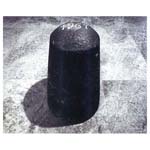
In December 1967 Pistoletto presented an exhibition at Sperone’s gallery in which he initially showed just one work, Milestone [Pietra miliare], a stone post with “1967” engraved on the top.
For the opening of this exhibition he emptied his studio and published a manifesto in which he announced its opening.
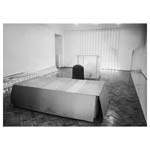
Over the following days he created, right there in the gallery, a group of works that he would refer to in a later note as “phenomena of the cube and of light: first creative act after the milestone.” It consisted of a cardboard parallelepiped, cutouts of polystyrene and pieces of frosted glass, a cubic structure made of wood and transparent plastic and some works based on light and its reflections that utilized candles, electric cables, lightbulbs, acetate and the walls of the gallery.
The same month he wrote and published an important theoretical reflection on the sense and direction of his work entitled Famous Last Words [Le ultime parole famose], a short and pregnant text split into two parts called “Speculation” and “Being” respectively.
“Opening up my studio was a ‘technical’ thing. I had almost always had a relationship with young artists
in Turin. As I had ‘opened’ paintings to the presence
and participation of all, why not ‘open’ a physical
space instead?”
(M. Pistoletto, interview with M.
Bandini, NAC [Bari, November 1973])
“The purpose and result of my Mirror Paintings was to carry art to the edges of life in order to verify the entire system in which both of them function. After this, there remains only one choice. On one hand there is the possibility of a monstrous involution and a return into the system of doubling and conflict; on the other hand there is the possibility of revolution and leaving the system altogether. One can bring life to art, as Pollock did, or one can choose to bring art into life - but no longer in terms of metaphor. [...] The way I move now is by stepping to one side. Every piece I make is a liberation and not a construction that is intended to represent me. I am not reflected in them, and the others cannot reflect upon me by means of them.”
(M. Pistoletto, Le ultime parole famose, Turin 1967)
From January 1968 onward Pistoletto’s studio became the venue for a busy schedule of events, open to the public, in which artists, poets, musicians and in particular a group of young film directors took part.
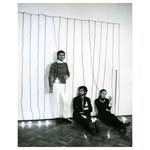
“Many people who had read the manifesto came to the studio and the space turned into something really wonderful. Every day people came there with things to show, to do. They started screening their films, reciting their poems, and the public came to see and listen, so there were continuous encounters. I went on doing my work, to one side, as there were two rooms in this studio, a smaller one and a much bigger one. The smaller one was where you entered and I created a sort of deconditioning chamber in the entrance, so that the people who came to see the screening of a film or listen to a recital of poems or to music were religionized, that is to say they entered with a sense of religious attention. [...] Another time there was one of my Mirror Paintings on the rear wall and the subject of the picture was a canvas projection screen, set in the middle of the mirror. Then there was the screening of a short film of theirs, projected onto my mirror painting, so that people saw themselves watching the film. Another evening there was a curtain of lightbulbs between the two rooms, with the wires of the lit bulbs hanging down, so that everyone had to be very careful passing through, both out of the fear of getting a shock and so as not to break those bulbs, which knocked against one another and gave an impression of the fragility of the moment.”
(M. Pistoletto interviewed by G. Celant, in Pistoletto, p. 68)
Invited to hold a solo exhibition at L’Attico in Rome in February of the same year, Pistoletto made ten films with the same number of young directors from Turin. They were mostly shot in his studio during the month between the day of the exhibition’s opening and the day of its closure, when the films were shown to the public.
In April, invited to show his work in a room of his own at the Venice Biennale, he published an invitation to work with him on that occasion: “With this manifesto I invite all those who wish to, to collaborate with me at the 34th Venice Biennale. By collaboration I mean a non-competitive human relationship based on shared values of sense and perception. To give a part of myself to those who wish to give a part of themselves is the work that interests me.” The intervention would never take place as a result of the political protests that were being staged, which he felt would have made its nature ambiguous.